
Archives: Publications
Post Type Description
In Emerging from the Pandemic, Use a Telescope, Not A Rear-view Mirror
You Are Not the Person I Hired
Delegating Authority Amid Growth: Dos and Don’ts

Rapid growth in a company is welcome. Still, it brings along two crucial challenges that, if mishandled, can overwhelm the company’s key executives. Those two challenges are hiring and delegating.
Most growing companies are constantly hiring staff and reassigning roles. Hiring needs to be planned and executed methodically. I am aware of numerous bad hiring processes and hires, with devastating results. Many resources outline the most appropriate ways to recruit and hire. The best book I have read on the topic is You’re Not the Person I Hired. The authors highlight all-too-common mistakes made during the hiring process and advise on how to reduce the risk of a poor hire. If you read only one book on growing companies’ hiring strategies, this should be it.
The real test of whether the hired person was appropriate for the role occurs once the individual is in place and responsibilities are delegated to him or her. In this article, I will discuss two types of delegation: vertical delegation and horizontal delegation. Each carries distinct challenges.
Vertical Delegation
Vertical delegation typically results from a company’s growing and its staff being stretched to the point of becoming overwhelmed. The company’s veteran staff members knows how to perform certain tasks but require additional hands – either new hires or delegating to other veteran employees. Most literature on delegation focuses on this delegation, which is vertical: It is done by supervisors to subordinates in a hierarchical relationship. In The One Minute Manager, co-author Kenneth Blanchard discusses the situational-leadership model. It focuses on ways a supervisor delegates great quantities of work to a subordinate. The process involves the supervisor’s assessing specific responsibilities and his/her current capability and aptitude to undertake them; alongside that, the supervisor (a) assesses the subordinate’s ability to assume some of that responsibility, and (b) uses appropriate amounts of direction and support to achieve the outcome and build the delegate’s confidence over time.
Horizontal Delegation
Horizontal delegation is a wholly different challenge. It involves delegation that occurs when the manager lacks key experience, doesn’t know how something should be done and doesn’t fully understand the details required to fulfill the responsibility. This is called horizontal delegation because the supervisor is somewhat on par with the individual and needs to put more trust in the individual than in vertical delegation. In this case, detailed directing and tight supervision is not really workable because the manager really does not enough of an understanding of how the task is to be performed. This situation commonly occurs in growing companies when business leaders understand that, to keep the company on a healthy growth path, an activity needs to be done either qualitatively better or an activity new to the company needs to be performed. Many approaches outlined in the situational-leadership model cannot apply directly to horizontal delegation.
In my experience, two of the most common pitfalls of poor horizontal delegation include:
• Where a task is delegated but the leader still micromanages the person to whom the task was delegated. This goes against the intent of delegation, does not relieve the leader’s burden and does not let the other person use his/her experience and knowledge to own the new responsibility.
• Where the leader gives total independence to the colleague, and totally removes the burden of thinking about the delegated responsibility. This could lead to a lack of coordination between the leader and the colleague. Such internal misalignment that occurs during the company’s active growth can create a situation where the delegate does not fully understand the context of their work and spends time and resources doing something that is not productive. A common occurrence is that the delegate assumes that the way they did something at another company should be copied and done exactly the same way at their current company.
Both pitfalls are cause for concern. Effort needs to be put into achieving a middle ground of providing clear context of the role, combined with a level of freedom. Below are listed some of my guidelines for effective horizontal delegation:
Plan for Success
• Determine if the person is both qualified and competent. If not, pivot and get the responsibility and role fulfilled some another way; otherwise, it has a low probability of success. You may want to provide an opportunity for an internal candidate to stretch, but do not set stretch expectations too high.
• Give 100 percent of the responsibility to one person and make sure that he/she knows it. There might be a tendency for some delegates to redelegate to others, which might be okay, or to delegate back, which is not okay.
Manage Along the Way, but do not Micromanage
• Outline how the person’s new responsibilities will help the company succeed – and the downside of not getting it right. The leader needs to abandon the supervisory role in favor of an evaluating role.
• Clarify the result being sought, put it in writing and get double and triple confirmation that this is understood. However, do not direct the person how to attain the goal, unless asked.
• Set a deadline for what is delegated and write it down.
Feedback
• The leader might be the primary cause of a poor delegation outcome. If the leader has not mastered horizontal delegation skills, it is not reasonable to blame others. Unfortunately, not spending time to provide adequate context and intent is all too common and the leader needs an open mind to recognize his/her own failing and be willing to take the blame for poor horizontal delegation, and rectify it.
• Set communication intervals for check-ins: initially often, then much less often.
• Not everyone is a peak performer the first time assigned to do something. Accept the fact that even well-qualified, competent people do not get it exactly right, especially the first time in a new environment. Even experienced people have room to develop and build self-confidence. Feedback should be given with the goal of building people up, not knocking them down.
Conclusion
Especially in a growing company, horizontal delegation is necessary to expand the range of activities and acquire talent to take responsibility to fill those roles. Even if done with the best of intentions, it can backfire. Though necessary, do not view delegation as simply a quick fix to unburden a business leader and then have someone else to blame if results are disappointing. Whether referring to vertical delegation or horizontal delegation, business managers and leaders should expect to:
• evaluate the delegate’s competence before delegating the responsibility
• clearly communicate the desired outcome and its impact on the company
• establish evaluation criteria
• understand that success or failure depends on a two-way relationship of mutual respect and trust.
What’s So Hard about Growth?

Growth is not just about size, but also about change.
I cannot count the number of times I have been asked, “Why is growing my company so darned hard?” followed by, “My sales are increasing, but so are my expenses, and I do not seem to be getting ahead.” My short answer is that healthy growth requires deciding to and actively implementing necessary growth-focused changes.
Here are four aspects of business that typically limit a middle-market company’s growth: Cognitive overload; Selecting a single growth strategy; Overcome incrementalism and Calibrating the big versus small mindset,
• Cognitive overload. In their book Scaling Up Excellence: Getting to More Without Settling for Less, Robert Sutton and Huggy Rao describe a common and, I believe, universal phenomenon of leaders thinking about too many things, while not focusing on the most important moves to support the business’s growth and health. This is manifested in many ways. The one way I find most common is when leaders of growing organizations, instead of devoting their attention to the key responsibilities they excel at, hold onto responsibilities that they could easily delegate to others with no ill effects. When I hear, “I’m too busy,” it frequently means that the leader is still trying to do things that he/she should have delegated to others.
• Strategy. A founder of a company typically will have already spent much time researching whether there is a market for the product/service, and then establishing a market position. In those efforts, multiple strategic paths might be attempted until settling on the key one that generates success. As a business matures and sales increase, growing a company frequently requires determining a primary operational strategy that has built-in efficiencies and is scalable, at the direct expense of secondary strategies. Getting the company to focus its attention and resources on a primary strategy (its growth engine) requires making a commitment to enable efficient scaling. It also typically requires abandoning an approach that might have been productive early on if it has less potential for success as the company expands.
• Incrementalism. This means that change will be implemented in small steps, but possibly too small to have a meaningful impact. The advantages: It’s typically a more comfortable approach than making large-scale changes (such as dramatically changing processes, systems and talent), and it reduces the risk of a negative decision. The disadvantage: It delays and even prevents a significant change that the company needs to grow. This manifests in many areas of business but is very common regarding acquiring and deploying key staff members and more narrowly defining their roles and responsibilities.
• Perspective/Mindset: thinking that you are smaller or bigger than you really are. Small companies typically operate on a shoestring budget and ad hoc processes and do not invest time in developing efficient processes or systems or in recruiting and organizing talent that will enable growing the company to the next level. They operate this way under the false assumption that there isn’t time. They also may lack confidence in their business model’s ability to scale. In his classic book on growth, No Man’s Land: Where Growing Companies Fail, Doug Tatum articulates the tricky position that business leaders face during growth: that their companies are “too big to be small, but too small to be big.” Tatum means that for some aspects in a growing business, a company might still view itself as an entity that’s struggling to survive – when, in reality, it has surpassed that point of concern. He also writes of companies that believe that they should have the same structure, processes and systems as much larger companies – but that approach, too, would be inappropriate and unjustified. Deciding which aspects of the business to change immediately to enable scaling, and which changes can wait, should be the key drivers of business transformation that enables growth.
Are Branding and Customer Loyalty in Decline

Established Brands Beware! Opportunities for Growing Companies!
Conventional wisdom holds that you need to build a trusted brand to get people to spend their money, and that establishing a brand is notoriously expensive. Branding generally includes increasing awareness and name recognition through heavy advertising.
That was then. It can be argued that a fundamental shift is occurring in the way consumers evaluate and purchase products and services.
Customers can now more clearly consider a product’s absolute value, as opposed to its relative values. Relative evaluations are comparisons with another product that is prominent or is placed in front of shoppers on a store shelf or catalog page. But absolute evaluations go beyond those constraints by using the most relevant information available about each product and feature – and absolute evaluations usually produce better answers.
Absolute valuations are now possible because technology provides much more powerful tools to gather information and process it to assess the quality of products and services. A recent example of this is Angie’s list, where consumers in a cohort share their experiences and evaluations of residential service providers. A somewhat old example is the way aggregation tools were applied to airline tickets. Prior to the 1990’s, a customer had to call an airline or, early in the Internet age, go to a single airline’s website to inquire about a flight. This search was limited to looking for airlines that the customer was familiar with. Conducting comparisons was very challenging. Aggregation sites like Kayak vastly improved the process because customers could determine the absolute value of an airline’s flight schedule and price by comparing alternatives side-by-side. Other aggregation tools, advanced search engines, reviews from other users, social media and access to experts enable consumers to make better decisions without having to rely on relative evaluations.
Absolute value in this context does not mean the best option; rather, it means the “good enough” solution that can vary depending on the individual consumer’s subjective preferences. The point is that customers can more easily determine the absolute value of something – and get closer to knowing what their experience will be with an individual product.
In the past, consumers used their own experience with a brand as a key quality proxy. They might reason the following: “In the past, I used Brand X. It was pretty good.” Their reference point was used to conclude that selecting Brand X has limited risk. But currently, when technology enables quality to be more quickly and objectively assessed, customers will be less hesitant to try something new. This enables newer brands to lower the barriers to entry and gain a foothold, at the expense of established brands with lower absolute value.
What helps support this conclusion are these two findings: 30 percent of U.S. consumers start researching products on Amazon and study reviews, with the average online shopper consulting more than 10 information sources prior to making a purchase. Brands, especially those that convey prestige, status and emotions, will continue to be of value. But, in realms where objective, specification-based quality is important – and can be assessed and communicated — relying on a brand may not be as reliable a market signal as it once was.
(Based on “Is Tech Eroding Consumer Loyalty,” Strategy+Business. Summer 2014)
Best Practices-Adapt or Adopt

When instituting a new process or upgrading an existing one, first identify “best practices,” that is: the gold standard for performing that practice. Best practices are a way to borrow processes from others who have learned from multiple iterations and have instituted a practice that yields positive results. But companies that attempt to institute best practices blindly tend not to be satisfied because they did not achieve the results reported by others. Two primary hazards exist for those instituting best practices:
- Failure to adapt. What works well in one company will not necessarily work well in another, unless the process is customized for the company’s culture, environment and people. Tailoring without diluting the core of the best practice is usually required.
- Failure to adopt. A borrowed process will only work with the commitment of leadership and those responsible for executing it. Be sure that you have support from all key constituencies before and during implementation.
Business Process Automation to Enable Growth

Technology enables the automation of activities or services that accomplish specific functions or improve workflow. Business processes exist for many operational aspects of company activities, and leaders planning for their companies’ growth frequently ask me if they should consider automating some of those activities. My answer invariably is that it depends.
Generally, “whether to automate” needs to be broadened from a stand-alone question dealing with a single process to one considering it in the context of an organization’s overarching business strategy. Analysis must first determine the scope of the automation question.
The absolute first thing to avoid doing, though, is having a technical team determine if automation is the correct approach. Technical teams are great at answering the “how” question – how to technically do something – but not at analyzing if it should be done. While such teams are great at understanding how systems can solve problems, translating a technical solution to a business solution is typically not their strong suit. I’d advise bringing technical people into the conversation later, so that they can be told the business reasons for considering automation and the goals being considered – and then let them solve a precisely defined challenge.
Generally, companies struggle with the question of whether to start with a simple process or a larger process. The larger process could be more critical to develop first, which would offer the greatest value from automation in efficiency and savings. See the table below for a comparison between issues related to automating a simple process versus a larger, more complex process.
| Comparison of Automation Efforts: Simple Versus Larger Process | ||
| Issue | Simple Process (Low-hanging fruit) | Larger Process (More critical, more potential gain) |
| Success Speed | Faster – fewer steps | Slower – more steps, more integration |
| Progress | Quick win, but noticeable by fewer individuals | Slower win but more noticeable day-to-day because it touches many individuals and has substantial, palpable impact |
| Chaos Control | Fewer people involved, easier to pay attention as issues emerge, then address them | Process automation time not properly estimated will generate doubts if it exceeds initial timelines and unexpected issues arise. Given the scope of the automation project, it might require extensive retraining and resistance by staff. |
| Process Importance | May not be considered critical in terms of cost savings, efficiency or improvements in customer relations | Larger, more important processes are generally deemed to be critical and likely to be given resources to improve upon them. |
| Return on Investment (ROI) | Lower | Generally, a higher ROI given the span of the process being automated |
Here are some questions that I tend to ask that could help determine which processes offer the most value from automation:
- Are there “paper heavy” processes? Is there a paper form (or e-mail or documents on a server) that gets routed to different participants as part of the process? Do your process workers waste time looking for forms or documents needed to complete a specific step?
- Does the process require manual duplication of data, where something needs to be keyed in from one place to another?
- Do processes “hang” because an individual was not alerted to proceed with the next step? Do other “routine,” time-consuming tasks halt the process in its tracks if the relevant employee is absent, overloaded with work or forgets?
- Are there “repeatable labor” processes, in which individuals do almost the same thing in almost the same way in almost all cases?
If you answered “yes” to any of these questions, you are looking at a process with automation potential. If you’re still not sure whether a process is a good fit for automation, or if you want more time to figure out the impact of such a “yes,” then it’s time to speak to the people who perform the process every day.
Understand though, that these process owners, (people who do it now), might be comfortable with the status-quo; in fact, they might find that the way they do today is ideal. It could be that many of them have already created workarounds to avoid potential process problems. Either way, these details need to be gathered to create an idealized automation scenario that reduces error rates and significantly decreases process cycle times.
To this point, you might have identified the benefit of automation, but what about other factors? Here are some that may lead you to not automate processes:
- Cost of Automation – What is the realistic ROI for automation? Include in this calculation the actual cost of automation, like software and hardware. Additionally, be aware of somewhat hidden costs, beyond salaries focused on this effort, testing the automated process, training cost and productive time lost to eventually become efficient at using the automation.
- What to do with exceptions to the automated process − What percentage of all the cases will follow the automated process and which cases should be handled as exceptions outside of the automated process? Are exceptions easy to identify? Can methods of handling exceptions be included in the automated process over time?
In my work with clients, after we have a clear strategy for growth, I frequently spend a fair bit of time focusing on processes and building models for processes. I ask this question: If business doubled, could you handle it the same way you are now? What generally results is that companies recognize that they have not paid serious attention to their current processes for a long time. The problem is that the processes in place have evolved without anyone having taken a step back to ask if this is the best way to do things. To really understand whether automation makes sense, you may want to start with a re-engineering effort (start with a clean sheet), as opposed to a process-improvement effort. Typically, performing process analysis with clients is quick, with some of the automation opportunities obvious and some processes too inconsistent (no hard and fast decision criteria that is a basis for automation) to automate.
Beyond that, determining the cost-benefit answer requires applying subjective judgment. There are no easy answers here, and even if automation is to be introduced in multiple steps, the order of its introduction is another question to be considered. Fearing their being inadequately prepared to grow, some companies automate too early or automate the wrong processes in the wrong order. More commonly, though, companies automate too late, and the expected economies of scale from growth are not realized because growth both uncovers and introduces inefficiencies.
One more thing: Companies readily automate customer-facing activities to save on the cost of an employee who answers the phone. While this may have obvious financial advantages, it can significantly hurt a company’s relationship with customers.
Automation – the how, what and when – is a key aspect of my consulting engagements related to growth. Let me know if I can help you.
Business Strategy is Often Limited by Company Structure

Companies can research and develop strategies that, in theory, would dominate a market, but not every company can execute a most-desired strategy, such as companies limited by how they are structured and how they function. For example, a company with many layers for securing approval to take action cannot generally move quickly, but also rarely makes a critical “process fumble.” By contrast, small entrepreneurial companies can change direction on a dime, but are subject to shortcutting processes that could hurt them down the road.
I like to use a very powerful analogy: In the northeast United States, the late summer and fall trigger activity in nature that enables different species of animals to deal with the lack of available food in the winter, each using a strategy unique to its structure and function:
- Birds fly south, where food is plentiful.
- Bears eat in excess and store large amounts of calories in their bodies, then hibernate in the winter to consume stored calories very slowly.
- Squirrels store calorie-dense nuts in the ground and access them as required.
These are structure-enabling and structure-limiting relationships. Bears and squirrels cannot make it to the south, like birds do, since they cannot fly. Squirrels and birds cannot store calories in their bodies, like bears can — and even if they could, they cannot reduce their metabolism rate and hibernate. Bears and birds cannot store food as squirrels do because they do not have the same incredible memory capabilities that squirrels have in relocating hidden food.
There is a lesson here: Just because there is an “ideal” or a “desirable” strategy does not mean that you can pull it off. A company is limited by how it is structured and how it functions today. You may ask dejectedly: Am I doomed to be stuck in a less desirable strategic position? The answer is decidedly “no,” because a business is not really restricted from changing its structure or function.
However, you cannot necessarily get there quickly without a concerted effort. The first step is to honestly assess existing structures and functions. Then, determining the key changes and the sequence of changes to implement requires a realistic sense of how change will be led and then reacted to by staff. Change is hard, and even harder to execute from within.
Classic Strategic Marketing- The Ansoff Matrix

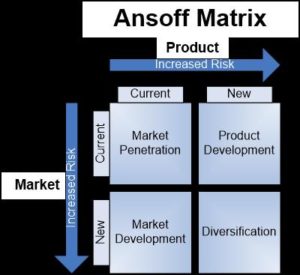
Middle-market businesses need simple ways to consider strategic market options. A simple and effective, compact tool is the Ansoff matrix, a simple, 2×2 matrix that guides planners in developing options.
Basically, it provides four options that are dependent on two variables: developing new products and entering new markets. Both involve expense and, therefore, risk. They also pose risks to the company brand. Here is a simple way to think of the four options:
Market Penetration-
How do you grow if you sell the same product to the same customers? Consider adjusting the marketing-mix elements: more effective promotion, product improvement and lower pricing. It is the least risky option, but likely to reap limited rewards.
Product Development-
If a company is entrenched in a market with respected products and services, it might be possible to sell that same set of customers other products. This leverages companies’ current market good will and credibility. The risk is going so far afield that customers would not relate the new product with the brand.
Market Development-
This is simply selling the same product to a different market. Brand might not be relevant at all, and the risk, therefore, is higher for companies penetrating a less-understood market.
Diversification-
The risk here is typically greatest: You don’t know that much about your product or the market. The rewards here are potentially substantial, but the failure rate is the highest. It is not uncommon for post-mortem analysis of failures to ask, “What were they thinking?”
My take-away thought for you is this: Obviously, there is a risk/reward equation to consider. My experience is that success is not only a function of a company’s ability to understand and mitigate risk, but also of a company’s being grounded in the potential upside of a business, which, all too often, is overly optimistic.
| Market Penetration- How do you grow if you sell the same product to the same customers? Consider adjusting the marketing-mix elements: more effective promotion, product improvement and lower pricing. It is the least risky option, but likely to reap limited rewards. |
Product Development- If a company is entrenched in a market with respected products and services, it might be possible to sell that same set of customers other products. This leverages companies’ current market good will and credibility. The risk is going so far afield that customers would not relate the new product with the brand. |
| Product Development- If a company is entrenched in a market with respected products and services, it might be possible to sell that same set of customers other products. This leverages companies’ current market good will and credibility. The risk is going so far afield that customers would not relate the new product with the brand. |
Market Development- This is simply selling the same product to a different market. Brand might not be relevant at all, and the risk, therefore, is higher for companies penetrating a less-understood market. |
The basis for this article comes from www.simonbrand.com.